 Gamma
Gamma fees depend on vault earnings, while transaction costs depend on execution
Gamma fees for liquidity management take a share of the trading fees that a vault earns. Network gas adds a separate cost when you transact. Comparing apparently similar deposits requires matching the vault’s fee terms, required approvals, any token conversions, and the network charges recorded after execution.
What's inside
Bottom line: A vault’s management charge applies to its fee income, while wallet transaction costs require separate accounting.
Management charges, pool fees, and network gas
Gamma’s LP management charge compensates the manager through a deduction from earned trading fees. The applicable rate belongs to the selected vault and integration. A percentage without its calculation basis cannot describe the cost accurately: a share of fee income differs substantially from a charge on deposited assets.
Pool swap fees have a separate role. Traders pay them when exchanging assets, and eligible liquidity earns a share under the pool’s rules. If preparing a deposit requires a swap, that conversion introduces its own trading costs. Merely supplying assets does not make every pool swap fee an additional charge against your deposit.
Network gas pays for transaction execution. A wallet’s gas estimate therefore does not describe the management deduction inside a vault. Keep those amounts separate when comparing costs.
Fee bases and the meaning of net earnings
Gross earned fees describe trading income before the applicable management deduction; net earned fees describe what remains afterward. Symbolically, if eligible earned fees are F and the management fraction is m, that deduction is F × m. The remaining fee income is F × (1 − m), before separately paid transaction costs. Apply the relationship to each token consistently, and use the vault’s actual accounting rules for rounding. Neither expression measures your total investment return. Changes in token prices and position composition also affect the value of the assets that your shares represent.
Why can similar Gamma deposits cost different amounts?
Similar deposits can require different transactions because spending permissions and network conditions differ between accounts and execution times. An existing sufficient allowance can remove the need for a new approval transaction. That allowance applies to a particular token, owner, and spender. Permission for another contract does not automatically cover the intended deposit. Where an approval transaction is necessary, its network charge belongs in the entry cost.
Even matching transaction types can consume different amounts of gas when they encounter different contract states. The price per gas unit can also change between blocks. These differences explain why copying another deposit’s displayed cost produces an unreliable estimate. Compare the same vault, funding method, permission state, and transaction scope before attributing the difference to Gamma’s management rate. A larger deposit also need not increase execution gas in direct proportion to the deposited amount.
Entry and exit choices that change the bill
Entry and exit methods determine whether the total includes approvals or conversions beyond the vault interaction itself. The choices below describe separate actions that may surround a deposit or withdrawal. They do not imply that every interface bundles them into one transaction. Available methods depend on the selected vault, token, and interface.
| Available approach | Cost condition or common mistake |
|---|---|
| Deposit accepted tokens with sufficient existing allowances | Avoids fresh approval transactions only when permissions cover the correct spender and required amounts. |
| Approve tokens before depositing | Separate approval transactions add gas; counting only the deposit receipt understates entry costs. |
| Swap tokens before depositing | The conversion adds trading costs and execution costs that the vault deposit estimate may exclude. |
| Withdraw and retain the returned tokens | Avoids a subsequent conversion; returned token quantities still depend on the position. |
| Withdraw, then swap the proceeds | The later swap adds costs; comparing its final output directly with an unconverted withdrawal is misleading. |
Final charges in transaction records
Transaction records separate execution charges from transferred assets and establish whether an attempted operation succeeded or failed. For an included transaction, use its actual fee rather than the wallet’s earlier maximum estimate. Record the network and transaction identifier alongside that amount. Approvals and other separately submitted operations have their own records. Explorer transaction details commonly expose status, transferred tokens, gas usage, and the transaction fee.
The execution component follows gas used multiplied by the effective gas price. Some networks add other fee components, so use the complete transaction charge for that network. A failed included transaction can still consume gas. A rejected request that never reaches onchain execution has a different status and should not automatically count as a paid attempt. Lowering the gas limit excessively can cause execution failure rather than a saving. If the transaction fails because it runs out of gas, retain its charge in your cost total and obtain a fresh gas estimate before retrying.
A pending estimate is not a final charge. Keep unresolved transactions separate from confirmed costs until their execution status becomes clear.
Vault deductions and the amount left in the position
Vault accounting explains management deductions that a wallet’s network-fee field cannot show. In Gamma’s Hypervisor v1.3 implementation, fee collection transfers the configured share of collected trading fees to the fee recipient. Collection can occur within a deposit or withdrawal call, so a management transfer in that receipt does not by itself establish a deposit or withdrawal surcharge. Match the transfer to the collected earnings and the applicable contract implementation.
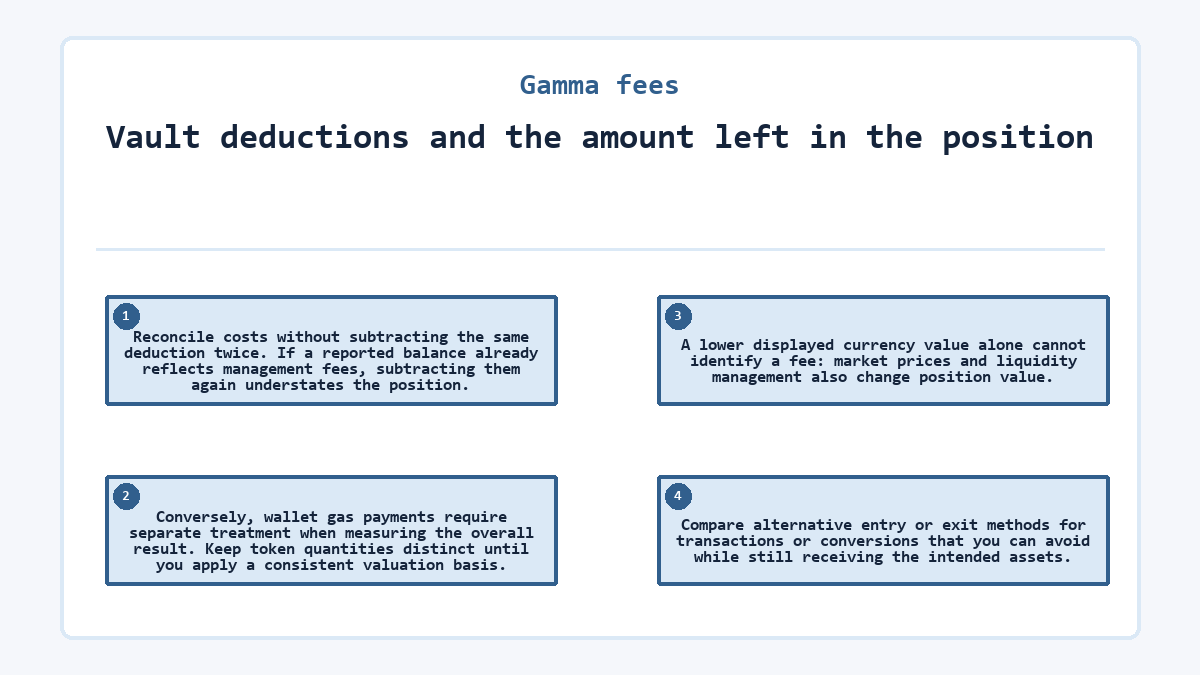
Reconcile costs without subtracting the same deduction twice. If a reported balance already reflects management fees, subtracting them again understates the position. Conversely, wallet gas payments require separate treatment when measuring the overall result. Keep token quantities distinct until you apply a consistent valuation basis. A lower displayed currency value alone cannot identify a fee: market prices and liquidity management also change position value. Compare alternative entry or exit methods for transactions or conversions that you can avoid while still receiving the intended assets.
Gamma fees: questions and answers
Can Gamma collect a management fee while my position loses value?
A deduction from earned trading fees can coexist with a decline in your position’s value. Trading income and total investment performance measure different things. Token price changes and the position’s changing asset composition can outweigh fee income. A management charge based on earned fees therefore does not establish that your overall holding made a profit.
Does increasing slippage tolerance reduce Gamma’s management charge?
Increasing slippage tolerance does not change the vault’s management rate. Where an action includes a swap, its tolerance controls the acceptable execution difference under that transaction’s rules. A wider tolerance can allow a less favorable output. Treat that setting separately from the management deduction and the network fee.
Is a fee APR the amount that I will receive after all costs?
A fee APR does not establish your personal return after all costs. An annualized fee-income figure has its own measurement period and calculation basis. Your entry time, holding period, wallet transactions, and position value changes also affect the result. Establish whether the displayed figure includes management deductions before using it in a cost comparison.
Which token pays for a Gamma vault’s management deduction?
In the Hypervisor v1.3 fee-collection implementation, management deductions use the underlying tokens in which the position collected fees. That mechanism differs from the network charge that the transaction payer incurs. Keep the token amounts separate in your records; a common currency total requires an explicit valuation basis.
Will an unlimited token allowance make deposits cheaper to execute?
An unlimited allowance does not set a lower gas price or reduce Gamma’s management rate. It can avoid later approval transactions while sufficient permission remains for the same spender. It also authorizes broader spending than a narrowly sized allowance. Compare that authorization scope with the cost of future approval transactions.
When should I convert transaction fees into a common currency?
Convert transaction fees when your comparison requires a common unit, while retaining the original token amounts. Use a consistent valuation convention across the transactions that you compare. Changing conversion dates can change the reported currency total even though the network charged exactly the same token quantity. Keep valuation changes separate from changes in actual fees.